

Wild honeys
Sweet alchemy: the eternal song of honey
Four honeys, four forage areas, four ways to use them — and why raw honey behaves differently from the jar you buy in a supermarket.
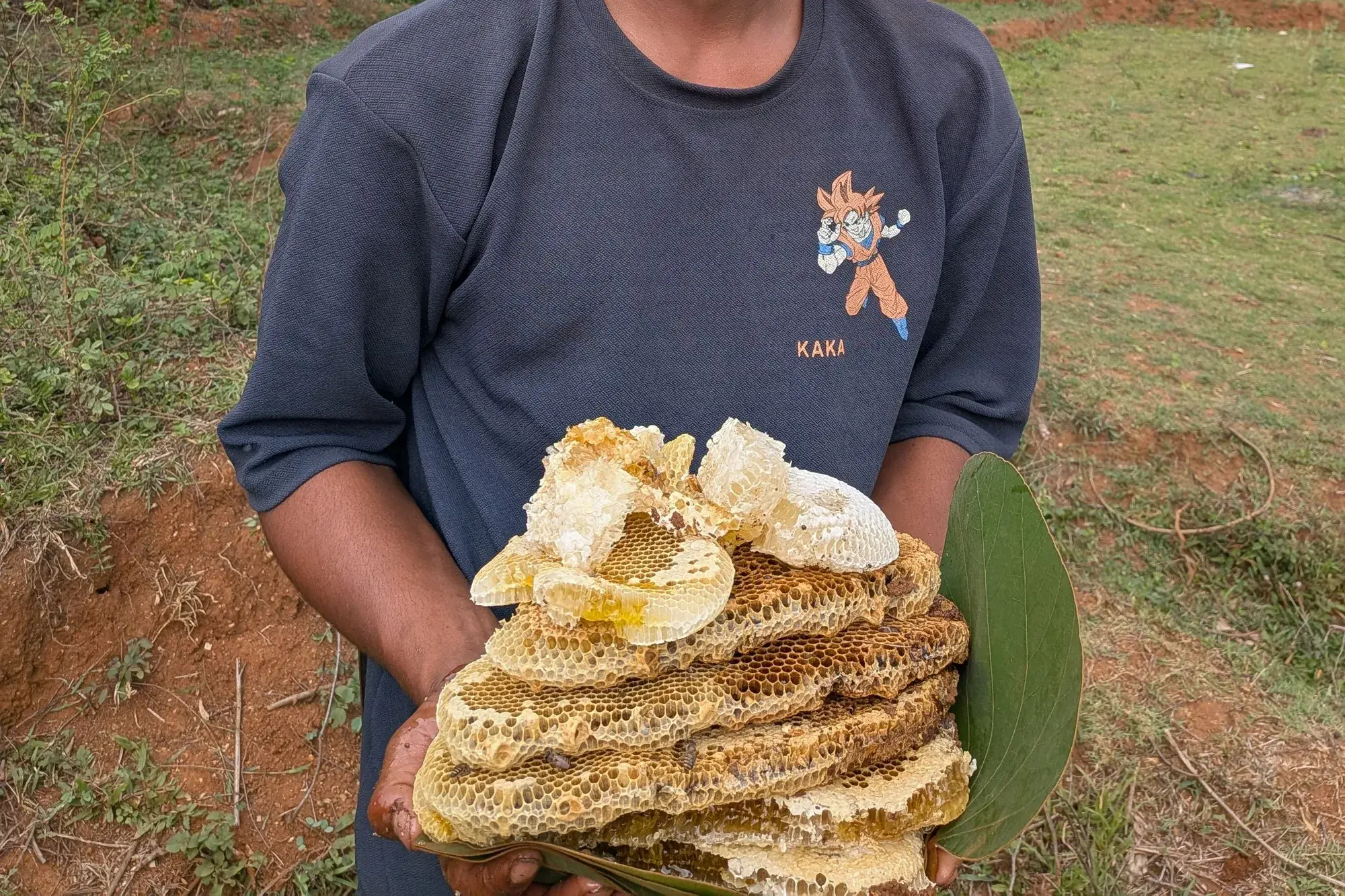
In the hush of wild groves where blossoms bloom unseen, a soft hum rises. Bees move from flower to flower, carrying the secrets of the forest. In their hives, warmth and time weave sunlight into liquid gold.
This is honey. Not made. Not manufactured. Conjured — a living essence in which flowers, forest and freedom are preserved in amber drops. Our grandmothers called it nature's memory.
The ancient tongue of honey
Across civilisations, honey was never simply food. In Sanskrit texts it is madhu: an offering, a sacred sweetener of ritual. Egyptian queens bathed in it. Greek athletes took it before competition. Ayurvedic texts name it a rasayana — a rejuvenator.
Honey was not traded like sugar. It was treasured like a jewel, because a hive gives what it gives and no amount of wanting produces more of it.
What raw honey actually does in the jar
Our honeys are raw and unpasteurised, and strained rather than pressure-filtered. That is a processing statement, not a marketing one, and it has consequences you will notice at home.
- It crystallises. In cooler weather raw honey sets and granulates. This is a sign it has not been heat-treated, not a sign it has gone off. Stand the closed jar in warm — not boiling — water for a few minutes and it returns to liquid.
- It is not uniform. Each honey comes from a specific forage area rather than being blended to a house style, so colour, body and flavour differ noticeably between the four, and shift a little from season to season.
- It keeps its pollen. Straining passes honey through a mesh to take out wax and debris. Pressure-filtering forces it through a far finer medium and strips the pollen out with everything else. Ours are strained only.
- It does not want boiling liquid. Let tea or water cool slightly before you stir honey into it.
When you taste them you don't only taste honey. You taste a mountain, a valley, a grove.
How to live with each honey
Honey is not only to be tasted; it is to be used. Each of the four has its own character, and a way of using it that suits that character best.
Clear Healing Honey
The mildest and lightest of the four — pale, clear-bodied and clarifying.
- Morning tonic
- A spoon in warm water with lemon, taken first thing.
- Everyday glow
- Mixed with a pinch of turmeric and used as a short face mask.
Seven Hills Honey
Multi-floral, harvested across rolling hill country. Lighter in body, more floral in finish.
- Warming cup
- Stirred into ginger tea or golden milk as a daily winter habit.
- Rustic spread
- Drizzled over fresh roti, sourdough or millet pancakes in place of jam.
Wild Forest Honey
Collected from colonies foraging deep mixed forest — dark, robust, and the strongest tasting of the range.
- Kadha
- Blended with turmeric, black pepper, ginger and tulsi through the cough-and-chill months.
- Forest glaze
- Whisked into a salad dressing, or brushed over roasting vegetables for a smoky-sweet finish.
Golden Parvat Honey
Honey blended with a base of traditional herbs, and the largest jar in the range at 200g.
- Evening chai
- Stirred into spiced herbal tea as a calming end-of-day ritual.
- After training
- Blended into a smoothie with moringa, banana and oats.
Our promise
Clear Healing, Seven Hills, Wild Forest and Golden Parvat are not factory-sweetened syrups. They are harvested ethically, unheated and unadulterated, and every jar states its net weight and its single ingredient. Inside each one there still hums the song of bees and the secrets of blossoms.
A note on claims. Everything above describes how these ingredients have traditionally been used, and how we suggest using them. Beyond Herba sells food, not medicine. Nothing here is intended to diagnose, treat, cure or prevent any disease.