

Wild honeys
Is your honey raw? What the jar can and cannot tell you
The water test, the flame test, the thumb test — what each one actually proves, why crystallisation is good news, and the four lines on a label that tell you more than all of them together.
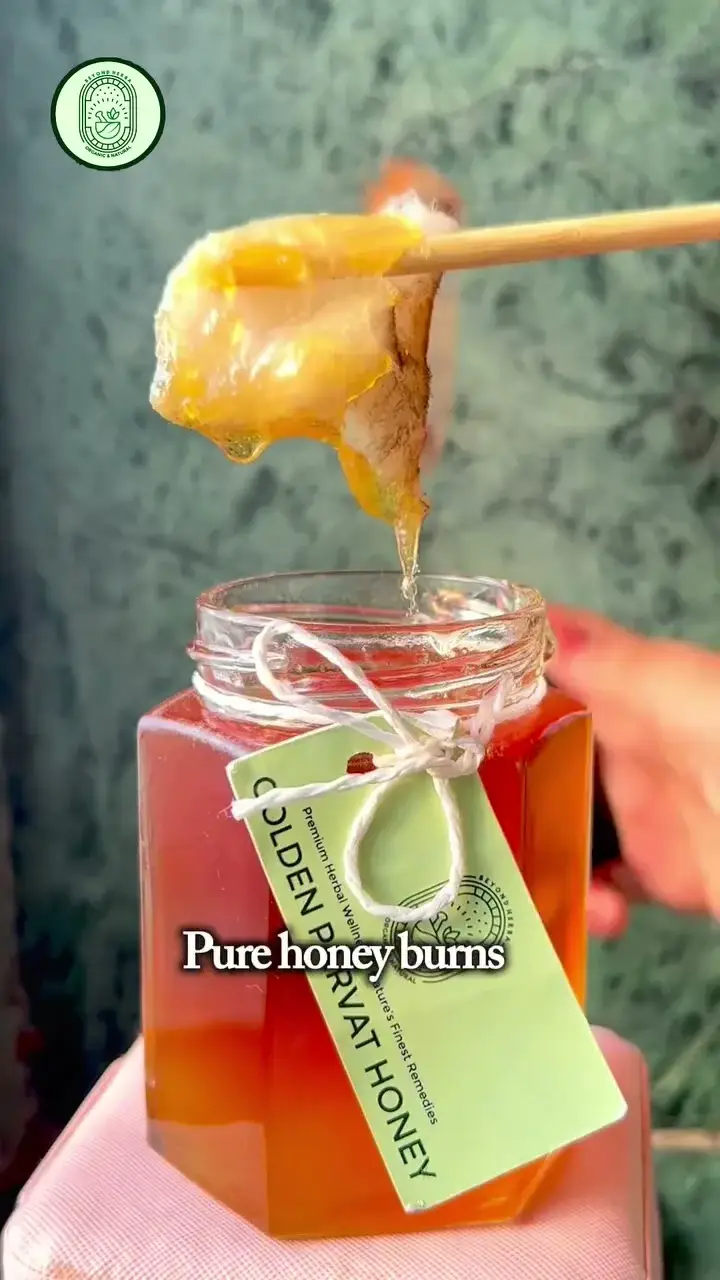
It is the question we are asked more than any other: how do I know this honey is real? It is a fair question. Honey is one of the most adulterated foods in the world, and India is not an exception to that.
The answer is not the one the internet gives. Most of the famous home tests do not test what people think they test — and the things that genuinely tell you something are duller, cheaper and printed on the back of the jar.
What raw honey actually means
Raw means the honey has not been heated or pasteurised, and has been strained rather than pressure-filtered. Those are processing statements, and they have consequences you can see at home.
- Pasteurising honey is done for the shelf, not for you. Heat delays crystallisation and makes every jar look identical, which is convenient for a supermarket and irrelevant to the honey.
- Straining passes honey through a mesh to take out wax and debris. Pressure-filtering forces it through a much finer medium and strips the pollen out along with everything else.
- Pollen is how honey can be traced back to a forage area at all. Once it has been filtered out, nobody can tell you where the honey came from, including the person selling it.
The home tests, honestly
The water test
A spoon of honey dropped into a glass of water is supposed to sink in a lump if it is pure and disperse if it is not. Thick honey does sink. So does thick sugar syrup. What this measures is viscosity, which is mostly a function of water content — not purity.
The flame test
A matchstick dipped in honey is said to light if the honey is pure and refuse if it is not. Again: it is measuring moisture. A drier honey lights a match more readily than a wetter one, and an adulterated but dry honey lights it perfectly well. It also involves setting fire to something in a kitchen for no useful result.
The thumb and paper tests
A drop that stays put on a thumb, or does not soak through paper, is once more telling you that the honey is not very wet. That is all.
Every one of these tests measures the same single property, and none of them detects the thing that actually goes into adulterated honey: rice or corn syrup blended in at the tank. Those syrups can pass all four tests. The laboratories that catch them use carbon-isotope ratio analysis, which cannot be reproduced at a kitchen table. Anyone telling you a matchstick proves purity is selling you something.
What does tell you something
- It crystallises. Raw honey sets and granulates in cool weather. It is the single most reassuring thing a jar can do, and the reason pasteurised honey never does it is that it has been heated so that it will not.
- It is not uniform. A honey tied to a real forage area changes with the season — colour, body and flavour shift between harvests. Perfect consistency jar after jar is a blending achievement, not a natural one.
- The label lists one ingredient. Honey. Not honey and fructose syrup, not honey and added flavour.
- The label states a net weight, a batch and an FSSAI licence number. Ours is on every pack and in the footer of this website.
- The source is named. Wild Forest, Seven Hills and Clear Healing are separate honeys because they come from separate forage areas — not a single tank divided into three labels.
- The price is plausible. Honey is a harvest. A jar priced like sugar was probably priced like sugar for a reason.
A jar that sets in December is telling you the truth. A jar that never does has been persuaded not to.
Living with a raw jar
- Do not stir honey into boiling liquid. Let tea, water or milk cool for a minute first.
- Always use a dry spoon. Water introduced into the jar is what causes honey to ferment.
- Keep it in a cupboard, not the fridge. Cold accelerates crystallisation.
- To reliquefy set honey, stand the closed jar in warm — never boiling — water for a few minutes.
- Honey is not suitable for infants under twelve months old. This is standard food-safety advice everywhere in the world and has nothing to do with quality.
Four honeys, four forage areas, and a straightforward way to decide which jar you actually want.
Clear Healing Honey
The mildest of the four. Pale and clear-bodied, strained rather than pressure-filtered.
- Buy it if
- You want the gentlest honey in the range, or you are buying for someone who finds strong honey overwhelming.
- Use it for
- Warm water with lemon first thing, and anywhere a delicate honey should not fight the food.
Seven Hills Honey
Multi-floral, from colonies working open hill country. Lighter in body with a floral finish.
- Buy it if
- It is going into tea and coffee daily and you do not want the honey to dominate the cup.
- Use it for
- Ginger tea, golden milk, and drizzling over roti, sourdough or millet pancakes.
Wild Forest Honey
Dark and robust, from bees foraging across mixed forest. The strongest tasting of the four.
- Buy it if
- You want a honey you can actually taste through everything else you put it in.
- Use it for
- Kadha with turmeric, pepper, ginger and tulsi, and as a glaze on roasting vegetables.
Golden Parvat Honey
Honey blended with a base of traditional herbs, and the largest jar in the range at 200 g.
- Buy it if
- You want a daily spoonful rather than a table honey. It is a blend, not a single-origin jar.
- Use it for
- Spiced herbal tea in the evening, or a spoon straight from the jar in the morning.
Common questions
Is crystallised honey spoiled?
No. Crystallisation is what raw, unpasteurised honey does in cool weather, and it is a sign the honey has not been heat-treated. Stand the closed jar in warm water for a few minutes and it returns to liquid.
Does the flame test prove honey is pure?
No. A matchstick dipped in honey lights according to how much water the honey contains, not according to whether sugar syrup has been added. Dry adulterated honey passes the test easily. The same is true of the water, thumb and paper tests.
How can I actually tell if honey is adulterated?
Not reliably at home. Syrup adulteration is detected in a laboratory by carbon-isotope ratio analysis. What you can do at home is read the label — one ingredient, a stated net weight, an FSSAI licence number and a named source — and watch whether the honey crystallises and varies between harvests, both of which pasteurised, blended honey does not.
Should honey be kept in the fridge?
No. Keep it closed in a cool, dry cupboard away from direct sunlight. Refrigeration makes honey crystallise faster.
Can I give honey to a baby?
Not under twelve months of age. This is standard infant food-safety advice and applies to all honey, raw or otherwise.
Why does this jar taste different from the last one?
Because it is tied to a forage area rather than blended to a house style. Colour, body and flavour shift from season to season, and the four honeys differ noticeably from one another by design.
A note on claims. Everything above describes how these ingredients have traditionally been used, and how we suggest using them. Beyond Herba sells food, not medicine. Nothing here is intended to diagnose, treat, cure or prevent any disease.